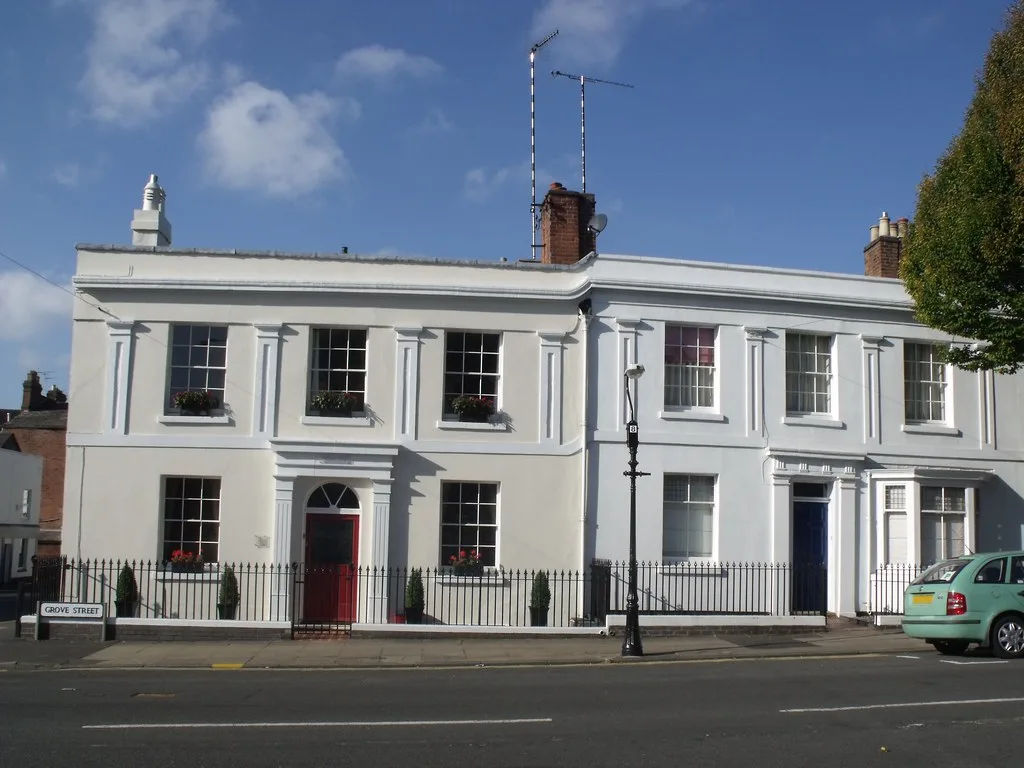

Councillors deferred a recommended refusal of vacuum double glazing at a Grade II Leamington villa, asking for evidence on past appeals and the new NPPF.
Warwick District Council’s planning committee has refused to settle the question every owner of a listed Leamington house eventually runs into: can you put modern glazing in a Georgian sash window?
Officers had recommended refusing listed building consent for new windows at 43 Brunswick Street, a Grade II listed villa. On 16 September the committee deferred the decision instead, and sent officers away to produce a fuller report. The council’s own summary of the meeting says members wanted a report that:
- provides factual evidence on previous relevant decisions and appeals
- offers clarity on the application of the updated National Planning Policy Framework
- includes further technical commentary on the reflective qualities of the proposed glazing
That is an unusually specific shopping list, and it goes to the heart of a policy change that landed six weeks ago.
What is actually proposed
The applicant, Gee Bee Investments Ltd, wants to replace fifteen windows in the villa. The application is for timber units with vacuum glazing on the front elevation and timber units with 12mm slimline double glazing on the rear.
The windows being replaced are not the originals. The officer report records that the units currently in the building are unauthorised 24mm double glazed timber units, which themselves replaced the pre-existing single glazed timber windows. Two single glazed windows survive at first floor level on the front, and those two are to be kept.
The applicant’s case is thermal performance. Vacuum glazing was chosen for the front because it is close to single glazing in appearance, without the bulk and reflection of conventional double glazing.
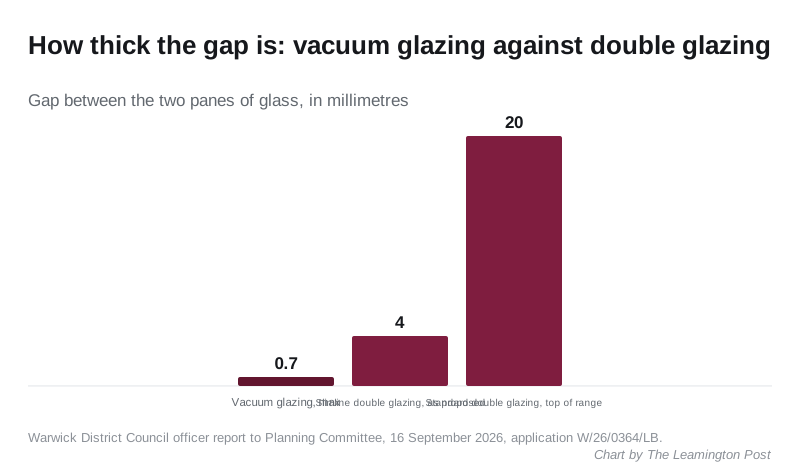
The difference is the gap. Vacuum glazing has a sealed empty space held apart by spacers, between 0.2mm and 0.7mm deep. Double glazing uses a thicker gap filled with an inert gas such as argon: 4mm in this application, and up to 20mm in general.
Why officers said no
Officers accepted the rear windows without difficulty. Their objection was confined to the front of the building, and it was specific.
The villa dates from 1818 to 1828 and sits at one end of a run of Grade II listed buildings at Nos 45 to 51, in an otherwise mixed street scene. It is not in a conservation area. Its front has five sash windows at ground floor and six at first floor, all in a six-over-six pane design, with a full height canted bay to the right and a pilastered doorcase.
The report says the large front windows are highly visible from pavement level and are therefore an important part of the building’s significance. The proposed vacuum units, it says, would be double the thickness of a single glazing pane and contain a grid of micro-pillars which read as dots across the glass. That bulk and manufactured appearance was judged to be at odds with the Georgian character of the frontage.
There was a second point that decided the case. Under the new framework, officers said the starting point is not the unauthorised windows sitting in the building now. It is the significance of the listed building before those windows went in.
The policy that changed in August
The National Planning Policy Framework 2026 took effect on 17 August 2026, and the report spells out what that does to a case like this one.
Policy CC2 means substantial weight is given to the energy efficiency benefit of new windows. Policy HE6 means substantial weight is also given to conserving a designated heritage asset. Both sides of the scale got heavier at once, and the officer’s job is to say which way it tips.
Historic England’s Advice Note 18, published in 2026, sits alongside it. Paragraphs 80 to 82 say that secondary glazing gives considerable thermal improvement and, on multi-pane windows, often outperforms double glazing. They also say slim-profile or vacuum double glazing inside historic frames is generally acceptable where the historic frames are retained, unless historic glass of interest remains, leaded lights are present, or the frames cannot take the alteration.
Officers concluded that because other, less damaging measures exist, the energy benefit was outweighed by the harm. The recommendation was refusal under NPPF policies HE4, HE5 and HE6 and Local Plan policy HE1.
Eight residents backed it, and that is why it went to committee
Applications like this are normally decided by officers. This one reached a public committee for a single reason, stated in the first line of the report: the number of support comments received, when the recommendation was refusal.
Eight members of the public wrote in support. The reasons recorded are improved energy efficiency, reduced heating costs and meeting EPC requirements. Royal Leamington Spa Town Council made no comments.
The Leamington Society objected, and its objection is the sharpest document on the file. The Society’s position is not that vacuum glazing is wrong. It writes that it is “not opposed in principle to vacuum glazing where historic fabric has already been lost and where the result would better restore the listed building’s character”.
Its objection is that nobody has established what was lost. It points out that the submitted planning history identifies only the 2002 basement and rear extension applications. It names no listed building consent for swapping the original single glazed sashes for the 24mm units now in place.
That matters legally. Section 7 of the Planning (Listed Buildings and Conservation Areas) Act 1990 prohibits unauthorised alteration of a listed building, and section 9 makes contravening it an offence. The Society argues the council should first work out whether the existing windows were lawfully installed, rather than treat them as the baseline.
It asked for a window-by-window schedule of age, condition, significance, glazing type and lawful status, a proper appraisal of the alternatives including repair, draught-proofing and secondary glazing, and large-scale joinery details.
The committee’s update report notes that the Society’s objection was not explicitly included in the officer report, though officers considered the principles covered.
What it means for you
Leamington is a town of listed and locally significant Georgian and Regency houses, and the heating bills that go with them. This case is the first test of how the council applies the August framework to that problem, which is why the outcome matters well beyond No 43.
Three things are worth taking from the papers as they stand:
- Rear windows are a different argument from front ones. Officers raised no objection at all to 12mm slimline double glazing on the rear elevation of this building.
- Replacing an unauthorised window does not reset the baseline. The council’s position is that the assessment starts from what was there before the unauthorised work.
- Secondary glazing is the route Historic England points at first for multi-pane windows, and the officer report leans on that heavily.
None of that is settled policy: the whole point of the deferral is that members want the evidence set out properly before they decide. If you are planning window work on a listed building here, the council’s informal guidance note, Windows in Listed Buildings and Conservation Areas, was updated in 2025 and is the document officers quote.
You can read the full file, including the officer report, the Leamington Society objection and the drawings, on the council’s planning register under reference W/26/0364/LB. We track the district’s bigger cases on our Leamington planning news page.
What happens next
There is no date yet for the application’s return. The committee asked for a fully detailed report, and the next scheduled Planning Committee is 6pm on 13 October 2026 at the Town Hall. Until members decide, the application stands undetermined and the recommendation on the file is still refusal.
One other Leamington listed building case was pulled from the same meeting. 35 Leam Terrace, W/26/0730/LB, was withdrawn from the agenda and deferred at the applicant’s request because amended plans had come in.
Sources
- Warwick District Council planning application W/26/0364/LB, 43 Brunswick Street, Leamington Spa, for the description of development, the 18 March 2026 registration date and the applicant.
- Officer report to Planning Committee, 16 September 2026, on the application’s documents tab, for the recommendation of refusal, the reason the application went to committee, the 1818 to 1828 date and description of the villa, the unauthorised 24mm units, the 0.2 to 0.7mm vacuum gap and 4mm to 20mm double glazing gap, the micro-pillar and bulk findings, the NPPF 2026 date of 17 August 2026, policies CC2, HE4, HE5 and HE6, Local Plan policy HE1, Historic England Advice Note 18 paragraphs 80 to 82, the eight support comments and the town council’s nil response.
- Update report to Planning Committee, 16 September 2026, for the note that the Leamington Society objection was not explicitly included in the officer report, and for the withdrawal and deferral of W/26/0730/LB at 35 Leam Terrace.
- Summary of Decisions, Planning Committee, 16 September 2026, published by Warwick District Council on the application’s documents tab, for the terms of the deferral. The council states on the face of that document that it is a summary and not the formal minutes.
- Leamington Society objection dated 30 June 2026, on the application’s documents tab, for its requests and its stated position on vacuum glazing.
- Warwick District Council Planning Committee meeting dates, checked 24 September 2026, for the 13 October 2026 meeting, listed as scheduled for 6pm to 8pm at the Town Hall.
Have your say